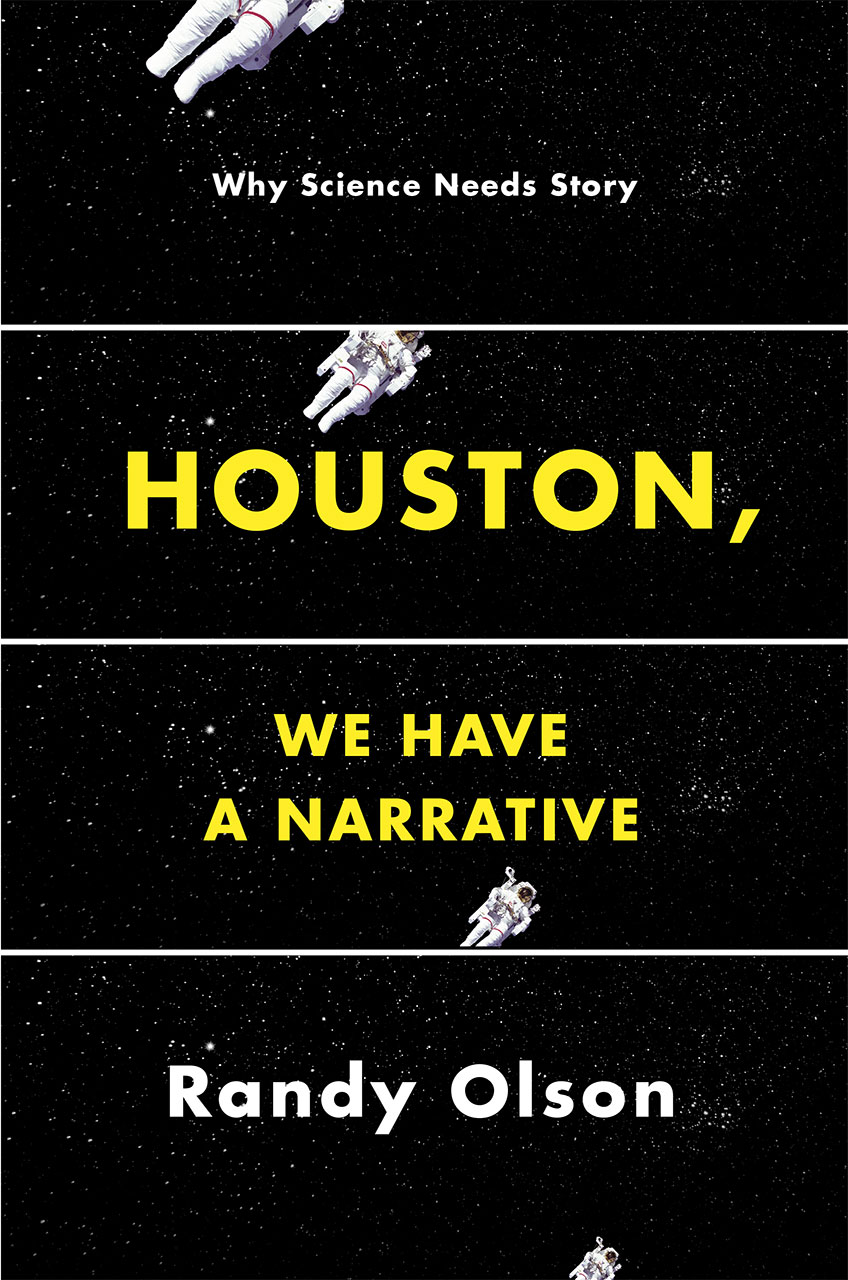
Randy Olson wants scientists to learn narrative but they have a tendency to want things to be complicated. Scientists love complexity, it's true, but narrative is about simplicity, not complexity.
"It's all the same story."
Olson insists that science and story follow the same structure. In fact, he says, "Dude, it's all the same story." Meaning ALL. Everything. De todo.Part of the problem with scientists is that they want to jump straight to the numbers, to the data. But we as the audience or readers, we want to care. We want to be moved. And numbers don't do that. Stories do.
The public gets bored with numbers alone. They want specifics. They don't want a jumble of facts, they want a story that moves them.
And stories have problems. People want solutions to problems, but they need real motivation, a reason to listen in the first place. Without a central problem, there's no need to listen. Scientists sometimes have trouble defining the problems that they're trying to solve.
No, really, it's all the same story
One of the central themes of part 1: Thesis is that all stories are basically the same. Whether it's science's introduction (why), methodology (how), results (what), and discussion (so what?) (IMRAD) or a standard piece of narrative literature like a novel, they all pretty much the same.Olson uses Joseph Campbell's 1949 work The Hero with a Thousand Faces to prove his point that narrative is all narrative; there's a common thread through all of it.
Part of what people expect from story or narrative is specifics. Olson says, "If I tell you the story of one little girl in Africa who is going to die next year from a disease, you are going to get upset by exactly X number of 'units of upset.' But if I tell you the story of two little girsl in Africa who will die from the disease next year, wouldn't you get twice as upset?"
But that's not how it works. Instead, "the death of one individual is a tragedy, the death of a million is a statistic." Too bad, but that's the way it works. Stories need specifics to be moving, to be powerful, to truly communicate.
Enter the humanities
Scientists don't take humanities courses, though. Well, most schools require a few general education humanities courses, but scientists in general don't like to take them. They seem like a waste of time. So scientists haven't internalized narrative. They haven't learned narrative intuition.So the humanities should be there to rescue scientists. After all, they're both on the college campus, so they should help one another.
But nope, the humanities are just a bunch of academic eggheads:
I'm afraid they're a bit of a write-off for the sciences when it comes to addressing this serious, and I think urgent, problem of narrative deficiency. Scientists need help, but they must get it from people who go beyond theorizing and work in the real world.
Hollywood to the rescue!
So what scientists need is Hollywood. Hollywood is cutthroat. If you can't cut it, you're cut. You're only as good as your last good movie.
And Hollywood understands narrative. Just like the humanities folks, Hollywood has developed the narrative intuition. They understand how narrative works. They have to. They must keep telling good stories again and again. They have to practice it. Their entire lives depend on it.
Not like those humanities eggheads who get their tenure and then stop caring. They never really even have to practice it.

No comments:
Post a Comment